

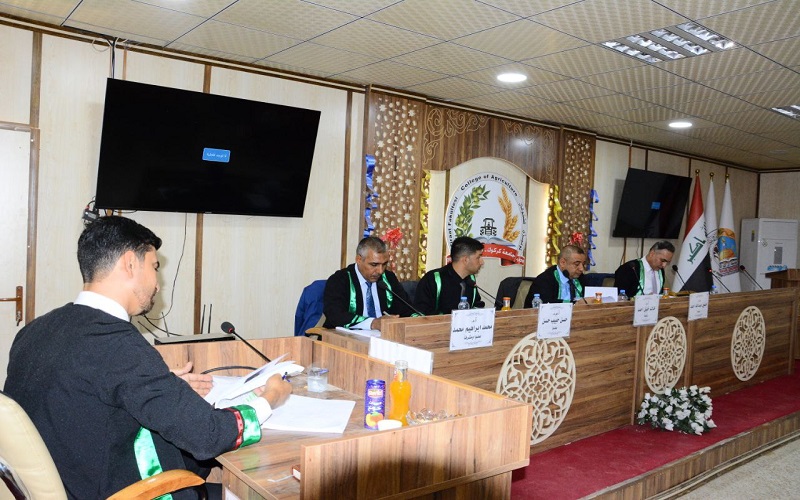
A master’s thesis at the College of Agriculture examined the growth, productivity, and genetic indicators of sorghum varieties when boron was applied at different growth stages of the plant.
The study, presented by student Ahmed Dhia Sukban, aimed to determine the best growth stage for boron application according to the sorghum growth scale, evaluate the performance of sorghum varieties in terms of growth traits, yield and its components, protein percentage, and to study genetic parameters, variances, and coefficients of variation of the varieties at each growth stage. It also sought to partition correlation effects into direct and indirect effects at each stage of boron application.
The study concluded that, among the different application stages, the first stage (five-leaf stage) outperformed in most traits. The two varieties Khair and J excelled in most traits, with the best combination being the first stage with variety J, as it showed superiority in most of the studied traits. Genetic parameters, variances, coefficients of variation, heritability, and genetic improvement values varied across all the studied application stages.