


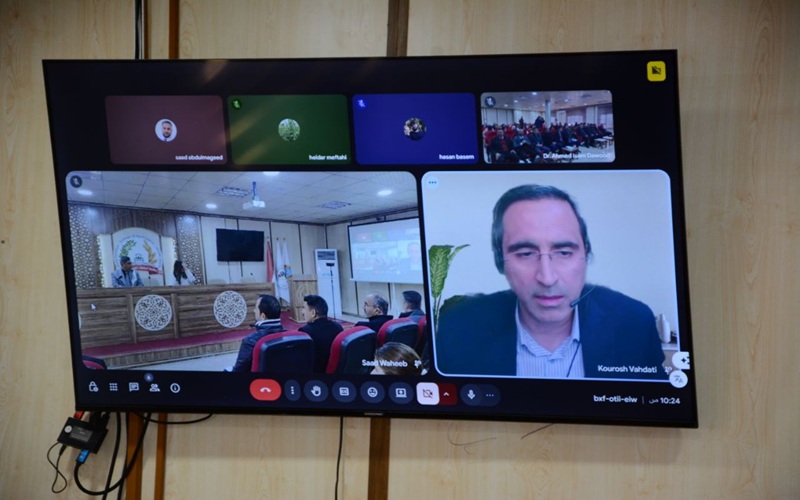
The Department of Horticulture and Landscape Design at the College of Agriculture organized a scientific advisory symposium on sustainable garden design strategies, attended by researchers and specialists in the agricultural field.
Symposium Objectives The event aimed to achieve several key goals:
-
Highlighting the principles of sustainable garden design and their role in enhancing natural resource efficiency.
-
Presenting strategies for selecting plants suitable for local environments to support sustainability and reduce water consumption.
-
Introducing smart technical solutions for irrigation and energy systems in modern gardens.
-
Raising environmental awareness among students and specialists regarding the importance of integrating sustainability into planning and design.
-
Discussing current challenges facing garden design in Iraq and seeking practical solutions.
-
Bridging the gap between academic concepts and field applications to enable designers and engineers to adopt modern methods.
Lectures and Speakers The symposium included lectures by specialists in landscape engineering:
-
"Zero Gardens": Presented by Dr. Saad Abdul Majeed Wahib, Head of the Department of Horticulture and Landscape Design at the College of Agriculture.
-
"Smart Design for Gardens and Orchards in Hot and Dry Regions": Presented virtually by Prof. Dr. Kourosh Vahdati, Head of the Horticulture Department at the College of Agriculture and Technology (Aburaihan), University of Tehran.
-
"Sustainable Gardens: Effective Design, Real Challenges, and Innovative Solutions": Presented by Asst. Lecturer Lina Saadoun Abdul Majeed from the College of Agriculture.
Recommendations The symposium concluded with the following recommendations:
-
Adopt sustainable design principles as a fundamental part of the methodology for creating public and private gardens.
-
Encourage the use of local and climate-adaptive plants to minimize water consumption and improve maintenance efficiency.
-
Implement modern, smart irrigation systems based on scheduling and soil moisture sensing.
-
Utilize renewable energy (such as solar power) to operate irrigation and lighting systems.
-
Include sustainable green spaces in new urban projects to reduce pollution and improve quality of life.
-
Foster cooperation between universities and municipal departments to develop model garden designs based on sustainability principles.