

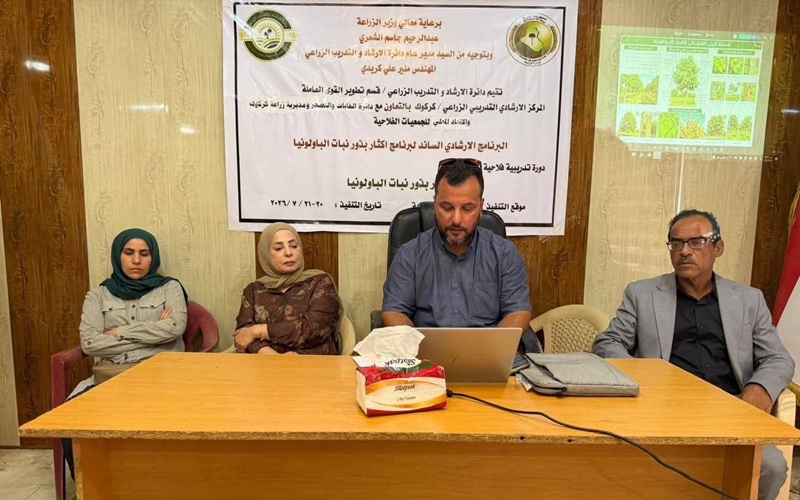
Mr. Mohammed Mumtaz Ibrahim, a faculty member at the College of Agriculture, University of Kirkuk, participated as a lecturer in an agricultural training course on Paulownia propagation organized by the Agricultural Extension and Training Center in cooperation with the Kirkuk Directorate of Agriculture—Al-Dibs Agriculture Division—the Directorate of Forests and Combating Desertification, and the Local Union of Agricultural Associations. The course was attended by a number of farmers.
The lecturer explained that his presentation covered both theoretical and field components. The theoretical section introduced farmers to the Paulownia tree, its economic and environmental importance, and its main applications, as well as the environmental requirements for its cultivation, including soil, climate, irrigation, and fertilization.
The lecture also covered Paulownia propagation methods, including seeds, cuttings, and tissue culture, with an explanation of the advantages and disadvantages of each method. It also addressed seedling care after germination, including irrigation, fertilization, pest and disease control, seedling thinning, transplanting into agricultural bags, and preparing seedlings for permanent planting.
The practical component included seed preparation, preparing the germination medium, and sowing seeds in germination trays. The field component involved a field visit to the Paulownia plantation at the Al-Dibs Forest Project.