

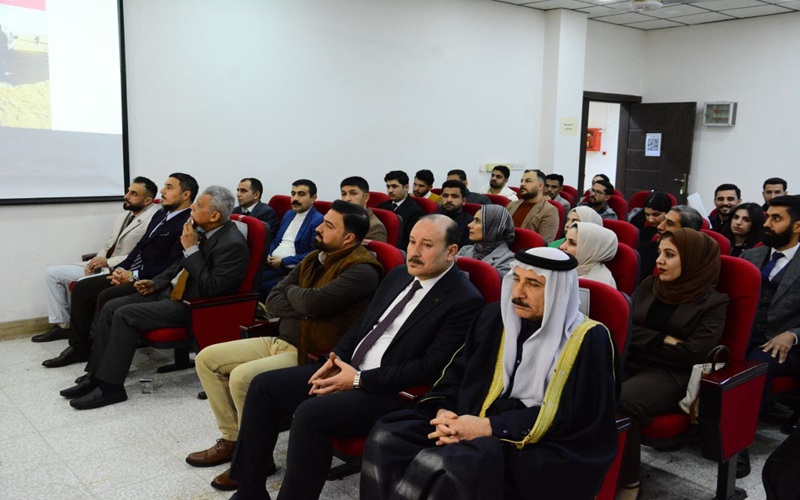
The Department of Field Crops at the College of Agriculture organized a scientific seminar on the use of selected smart agriculture applications in developing field crop cultivation. The seminar was attended by representatives from the Kirkuk Provincial Council, the Directorate of Agriculture, the Agricultural Extension and Training Center, the Agricultural Engineers Syndicate, the Local Federation of Farmers’ Associations, as well as researchers and specialists in the agricultural field.
The seminar aimed to highlight the importance of smart agriculture, whether water-based or organic, in achieving the highest possible productivity using minimal land area and reduced water consumption. This approach ensures sustainable agricultural production, preserves natural resources for future generations, reduces harmful greenhouse gas emissions to the lowest possible levels, and enhances the ability of agricultural systems to adapt to future climate change.
The seminar included several lectures:
- A lecture by Dr. Khattab Abdullah Mohammed on the use of solar energy systems in irrigating field crops.
- A lecture by Dr. Thikra Ahmed Hassan on nano-strategies for crop development and protection of the agricultural environment.
- A lecture by Assistant Lecturer Tara Yassin Ahmed on employing smart agriculture applications in diagnosing and controlling field crop pests.
The seminar concluded with several recommendations, including the need to provide government support to farmers through interest-free soft loans for purchasing solar energy systems, and organizing training courses to enhance farmers’ knowledge on the use and maintenance of solar systems. It also emphasized creating an enabling environment for establishing solar energy industries in Iraq by setting up factories to produce solar panels according to international standards.
Additional recommendations included integrating smart technologies with integrated pest management to combine traditional and modern methods for controlling weeds in field crop fields; training students to collect and analyze field data using smart technology software by incorporating these skills into core university curricula; developing programmed nano-fertilizers suitable for Iraq’s agricultural conditions; establishing nano-ecotoxicology evaluation protocols to assess the safety of nanomaterials before their commercial use in agricultural markets—especially those used in fertilizing field crops; and integrating nanotechnology with artificial intelligence by combining nanosensors with AI systems to create self-managed farms.