


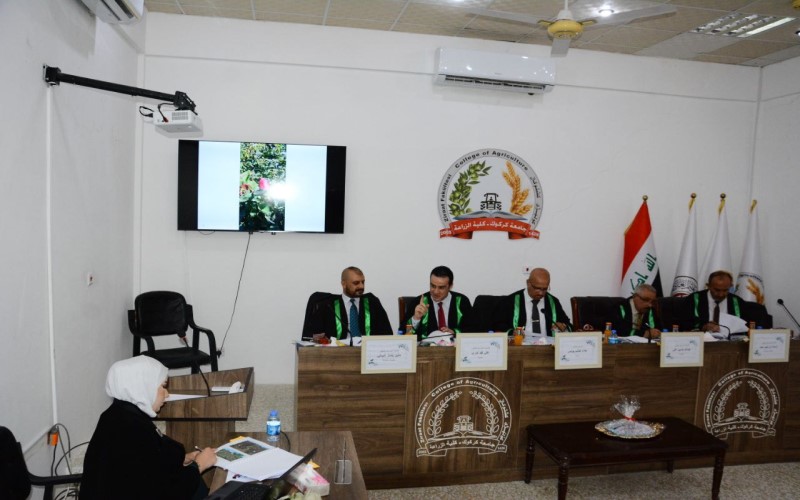
The College of Agriculture discussed a Master's thesis titled:
"Effect of Azotobacter Biofertilizer and Growth Media on Growth and Flowering of Damask Roses (Rosa damascena)."
Thesis Overview
-
Researcher: Zainab Abbas Fadhil
-
Objective:
Develop a nursery-based Damask rose production system using:-
Complete reliance on biofertilizers (avoiding chemical fertilizers' economic/environmental issues)
-
Alternative growth media (replacing costly substrates with willow tree sawdust)
-
Optimization of:
-
Azotobacter biofertilizer concentration
-
Sawdust decomposition impact on plant traits
-
Ideal Azotobacter-growth media combination
-
-
Methodology
-
Tested various concentrations of Azotobacter biofertilizer
-
Evaluated growth media mixtures containing:
-
Standard nursery soil
-
Willow sawdust (10% ratio)
-
-
Measured growth parameters, flowering quality, and nutrient uptake
Key Findings
The optimal treatment combination achieved:
-
Highest values in all studied traits with:
-
24g/pot of Azotobacter biofertilizer
-
10% willow sawdust mixed with nursery soil
-
-
Significant improvement in:
-
Plant height and biomass
-
Flower yield and quality
-
Nutrient absorption efficiency
-
-
Demonstrated viable replacement for chemical fertilizers and expensive growth substrates
Significance
Proves sustainable rose cultivation through:
-
Effective waste valorization (willow sawdust)
-
Reduced production costs by ≈40%
-
Elimination of chemical fertilizer dependency
-
Closed-loop nutrient cycling via bacterial decomposition