

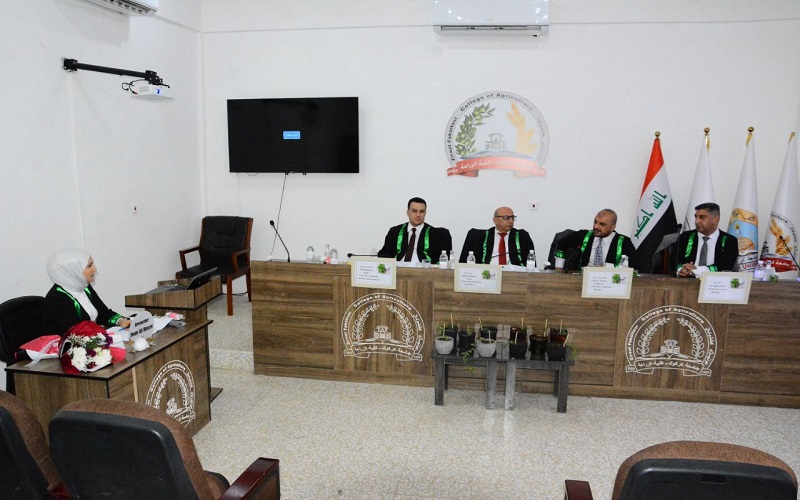
A master’s thesis at the College of Agriculture examined the in vitro propagation of Stevia rebaudiana.
The study, presented by student Jwan Ali Hussein, aimed to apply in vitro culture methodologies for plant propagation, produce genetically identical seedlings, study the effect of culture medium formulations and their component ratios on growth parameters, develop callus tissue cultures from plant explants, and evaluate the efficiency of tissue culture techniques, derived strategies, and synthetic seed engineering.
The study concluded that sterilizing shoot tips and nodes using sodium hypochlorite (NaOCl) at a concentration of 6% for 6 minutes achieved the highest survival rate (100%), confirming the effectiveness of this method in reducing microbial contamination. During the multiplication stage, the addition of benzyl adenine (BA) at 1.5 mg/L to the culture medium proved to be the most effective method in stimulating shoot formation. In the rooting stage, indole-3-butyric acid (IBA) at 0.75 mg/L achieved the highest rooting percentage (80%). The study also successfully produced synthetic seeds from callus tissues and shoot tips, achieving a 100% success rate when stored under refrigeration for 28 and 23 days, respectively.