 College of Engineering - University of Kirkuk
  Arabic
  English
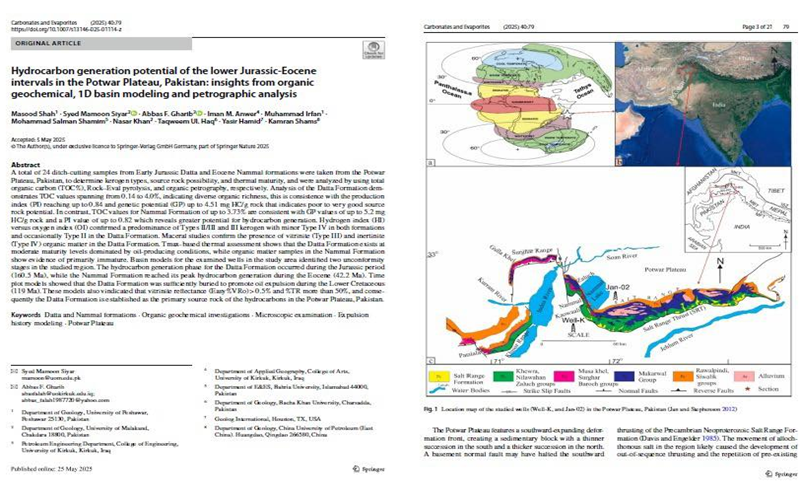
 Dr. Abbas Falah Ghareeb, a faculty member in the Department of Petroleum Engineering at the College of Engineering – University of Kirkuk, has published a research paper titled:
"Hydrocarbon Generation Potential of the Lower Jurassic–Eocene Intervals in the Potwar Plateau, Pakistan: Insights from Organic Geochemical, 1D Basin Modeling and Petrographic Analysis"
in the journal Carbonates and Evaporites (Impact Factor: 1.1), which is indexed in both Scopus and Clarivate databases.
The study focused on the source rocks of the Datta and Nammal Formations in Pakistan. It involved conducting geochemical analyses, including Rock–Eval pyrolysis and Total Organic Carbon (TOC) tests on 24 rock samples, in addition to petrographic analysis. The research was completed using a 1D Petromod basin modeling approach.
The results revealed that the Datta Formation contains organic matter ranging from poor to very good quality. Both formations were found to contain kerogen types II/III and III, with minor amounts of type IV, and exhibit appropriate thermal maturity levels for oil generation. The Nammal Formation, although containing good-quality organic matter, is still in an early stage of thermal maturity.
Basin modeling results indicated that oil generation from the Datta Formation began during the Jurassic period, confirming it as the main hydrocarbon source rock in the region.