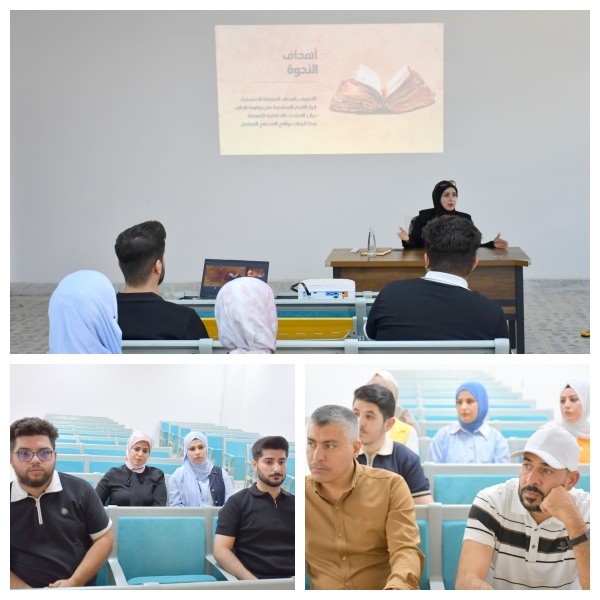

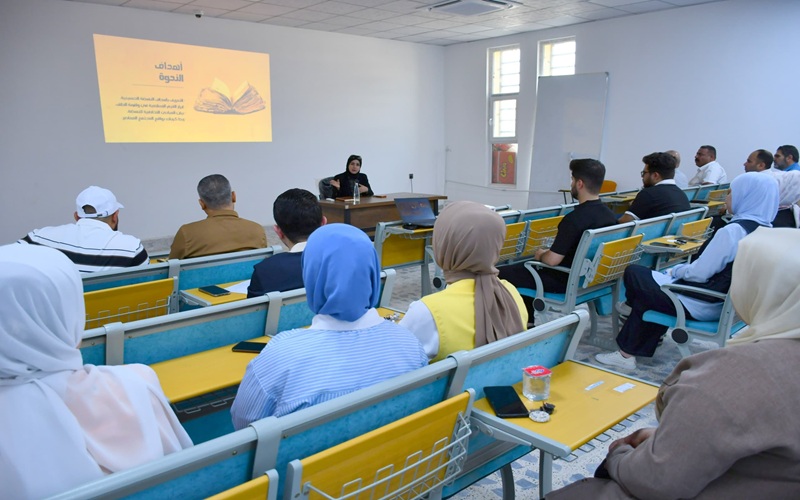
In line with the mission of the academic institution to promote scientific and intellectual awareness, encourage constructive dialogue, and reinforce Islamic and humanitarian values within the university community, the Continuing Education Division, in cooperation with the Women's Affairs Unit, organized a scientific seminar entitled “Imam Hussein as a Revolutionary and Martyr: Manifestations of Islamic Values and Moral Principles in Building Society.” The seminar was delivered by Assistant Professor Dr. Sukaina Ali Karim and was attended by a distinguished group of faculty members, researchers, and students in an intellectually engaging and interactive academic atmosphere.
The seminar commenced by emphasizing that commemorating the uprising of Imam Hussein (peace be upon him) should not be confined to its historical or emotional dimensions. Rather, it represents an important scholarly and intellectual opportunity to examine the system of values and principles upon which this enduring movement was founded and to draw inspiration from its significance in shaping individuals and society. The revolution of Imam Hussein (peace be upon him) was presented as a comprehensive civilizational model in defending truth, safeguarding human dignity, and promoting the values of justice, freedom, and reform—principles that continue to serve as essential foundations for building cohesive and resilient societies capable of confronting contemporary challenges.
During the seminar, the lecturer also explored the intellectual and ethical dimensions of the Husseini revolution, explaining that Imam Hussein (peace be upon him) introduced a comprehensive reform project grounded in authentic Islamic principles. This reform sought to revive the human conscience, confront deviation, oppression, and corruption, and establish the foundations of justice, equality, and respect for human dignity.
In conclusion, the lecturer affirmed that the Husseini movement was not an event confined to a particular time or place; rather, it has become an enduring humanitarian school from which nations continue to draw inspiration in the values of patience, steadfastness, sacrifice, altruism, and responsibility.